Reviewed and updated: November 4, 2026
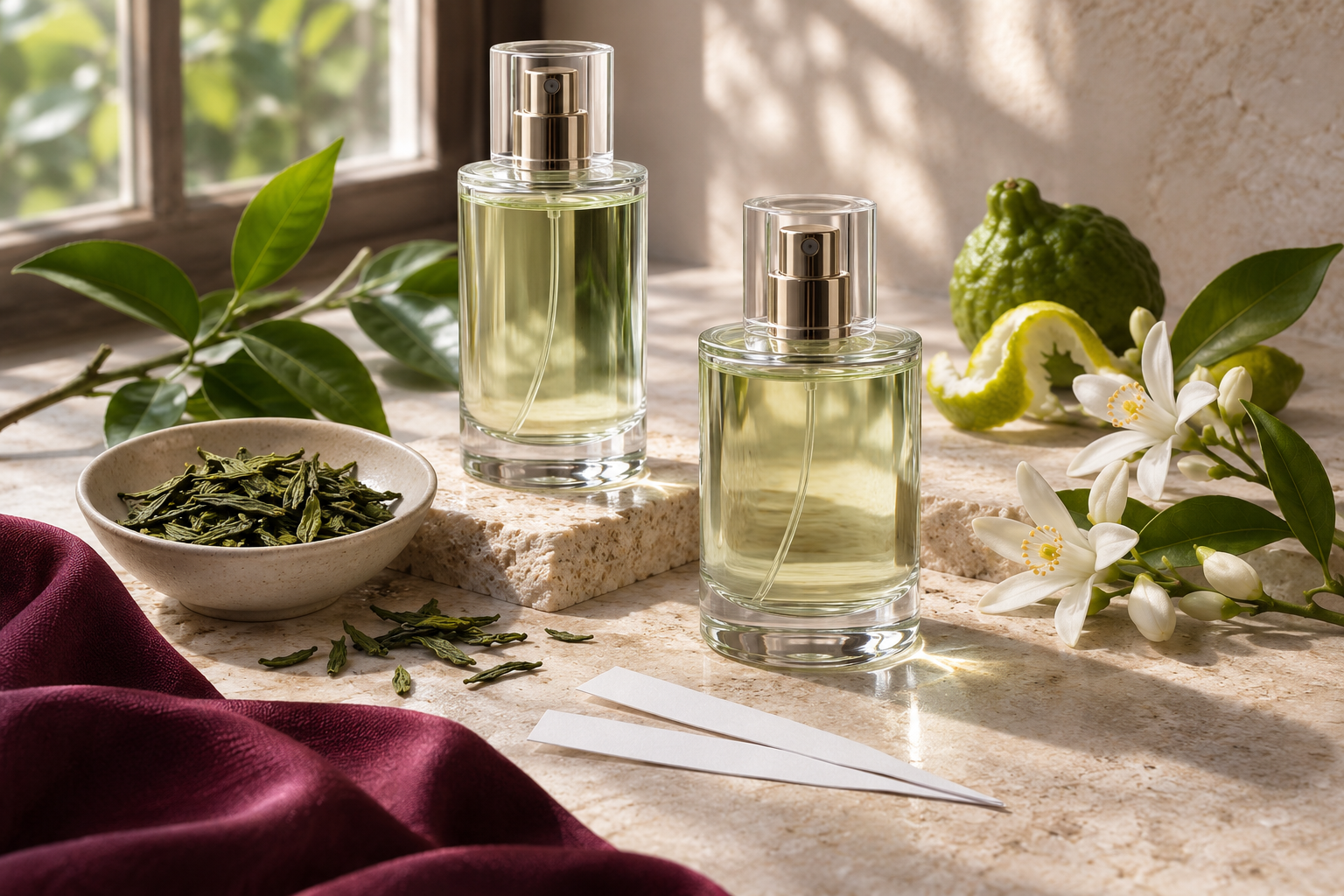
Green tea perfumes promise freshness, but that description alone does not tell you which bottle to buy. Elizabeth Arden Green Tea Scent Spray and Bvlgari Eau Parfumée Thé Vert Eau de Toilette approach the theme with different supporting notes and different product identities. Choose between them by the kind of freshness you enjoy, then confirm the exact version before ordering.
Elizabeth Arden is the starting point for someone drawn to a citrus opening with a varied green, floral and musky framework. Bvlgari deserves a closer look if your priority is the pairing of tea with neroli and you specifically want its current eau de toilette. Neither choice can be ranked for your skin from a note list alone. This comparison uses the brands’ current descriptions, rather than a hands-on wear test.
Two green tea fragrances to consider
Elizabeth Arden Green Tea Scent Spray
Elizabeth Arden describes bergamot and lemon, a heart of green tea accord, jasmine and celery seeds, and an amber, oakmoss and musk base. Choose it to explore citrus with a varied green backdrop. Skip it if you require a formally specified concentration or want tea without floral and musky supporting notes.
Bvlgari Eau Parfumée Thé Vert Eau de Toilette
Bvlgari describes the current eau de toilette through green tea, neroli petals and bergamot, with an upgraded formula containing natural tea. Choose it if that tea-and-neroli combination interests you. Skip a blind purchase if you expect a remembered older eau de cologne: verify the edition and sample the current formula first.
What the note lists actually help you decide
The useful question is not which fragrance contains the longest list of appealing ingredients. Ask which supporting direction you would be happy to smell repeatedly. If citrus is the main attraction, start by sampling Elizabeth Arden. If a floral tea pairing is the reason you are shopping, put the current Bvlgari on your shortlist. These are buying inferences from the descriptions, not promises about how either fragrance will develop on you.
Imagine two ordinary situations. You want a fresh scent to accompany a casual morning without choosing something dessert-like; both are plausible candidates to sample. Alternatively, you want a strong evening statement with a smoky or dense sweet character. These descriptions give little reason to make either your first purchase for that goal. A product can fit its category well while still being the wrong answer to your brief.
Treat notes as signposts rather than literal ingredients or a stopwatch. A tea accord does not mean the liquid will smell exactly like your favorite brewed tea. Our guide to reading perfume note pyramids explains why listed notes are more useful for narrowing a shortlist than predicting every stage of wear.
Choose the exact version before comparing bottles
Elizabeth Arden’s current product is named Green Tea Scent Spray. Its official FAQ does not specify a formal fragrance concentration, so do not assign it a percentage or assume every seller’s concentration label is definitive. Match the complete fragrance name and spray format. The Green Tea family includes other named versions and body products; a similar green package is not enough to establish that you have found this fragrance.
Bvlgari’s current Thé Vert page describes an upgraded formula and eau de toilette identity. That makes edition matching part of the purchase decision. A listing for an older Eau Parfumée au Thé Vert eau de cologne should not be treated as interchangeable evidence for the current EDT. If you remember a previous bottle fondly, sample the current version instead of assuming the name guarantees an identical experience.
This distinction also matters when reading comments elsewhere. Someone may be describing a different concentration, an older edition or a body product. Before using another wearer’s impressions to decide, check that the product identity matches yours. Our EDP and EDT guide gives context for concentration terminology without treating those labels as guarantees of strength.
How to compare them without buying both full bottles
Start with a paper comparison, giving each strip its own clear label. Keep the sprays separate and avoid repeatedly sniffing at close range. The first pass should answer whether you want to explore either scent further, not produce a final ranking. Step away between observations so the brighter opening does not dominate every decision.
Move a finalist to skin on another occasion, following the product directions and starting conservatively. Test without another perfume or strongly scented lotion competing underneath. Record whether you enjoy the opening, the later character and the overall experience in your normal setting. Our skin versus paper testing guide offers a simple way to keep those observations separate.
Do not buy a larger bottle simply because the first spray is appealing. Give yourself another wear and ask whether you still want it after the initial novelty passes. If both appeal, choose the one that adds a role your existing collection lacks. Two fresh fragrances can become redundant if you reach for them in precisely the same situations.
Neither a fresh note list nor an eau de toilette label establishes a reliable number of hours on every wearer. Dose, environment and your own perception complicate comparisons. We have not measured wear time or projection for these bottles. If lasting through a particular workday is essential, make that a question for your sample test before committing.
Freshness is also not permission to spray freely around other people. For a shared office or close indoor setting, begin with a modest application and respect fragrance-free rules. A scent that feels light to its wearer can still bother someone nearby. If fragrance causes discomfort or irritation, stop using it rather than trying to solve the problem by switching between these two.
Check the Amazon search result before ordering
The buttons above open specific Amazon searches, rather than a verified individual listing. Results can include other editions, gift sets, body products or third-party decants. Match the full name, concentration where stated, bottle size and packaging to the product you intend to buy. For Bvlgari in particular, check that the listing identifies the current eau de toilette when that is your target.
Read who sells and ships the item, what condition is described and which return terms apply. Do not infer seller authorization from the marketplace name or an attractive photograph. An incomplete title, contradictory photos or unclear version description is a reason to pause. A different bottle size is not automatically a better choice if you have not yet decided you enjoy the fragrance.
Which one should you choose?
Choose Elizabeth Arden Green Tea Scent Spray first if you want to explore its citrus-led green profile and are comfortable buying by its exact Scent Spray identity. Choose current Bvlgari Eau Parfumée Thé Vert EDT if its tea-and-neroli direction is the specific attraction and you are prepared to verify the edition carefully. Skip both for now if your real priority is a rich evening fragrance or guaranteed all-day performance.
For a gift, the recipient’s taste matters more than either brand name. If you do not know whether they like citrus, green or floral fragrances, a sample-led choice is more thoughtful than guessing at a full bottle. For your own purchase, let a second wear settle the decision: the best green tea perfume here is the one whose whole character you want to return to.